How To Get Promoted To VP: Make The Business Case

Most people answer “Why should we promote you?” like they’re asking for a gold star.
They answer “Why should we promote you?” as if leadership is evaluating effort, loyalty, or how hard they have worked. But at senior levels, especially when you are trying to get promoted to VP, that is not the decision executives are making.
If you’ve ever felt unsure about what actually gets you seen as promotable at this level, I break that down further here.
Senior leaders get promoted when they make leadership feel a little silly for not doing it sooner.
Because when a VP or exec asks this question, they’re not fishing for reassurance that you work hard. They already assume you work hard. You’re a Director. It comes with the job.
They’re asking:
Can you make a clear business case for why it’s smart to expand your scope, formalize your authority, and place a bigger bet on you?
If you answer from the “I deserve it” angle, you’ll keep hearing “maybe next time”.
If you answer from the “here’s why it helps the business” angle, you’ll win the promotion.
Let me prove it to you.
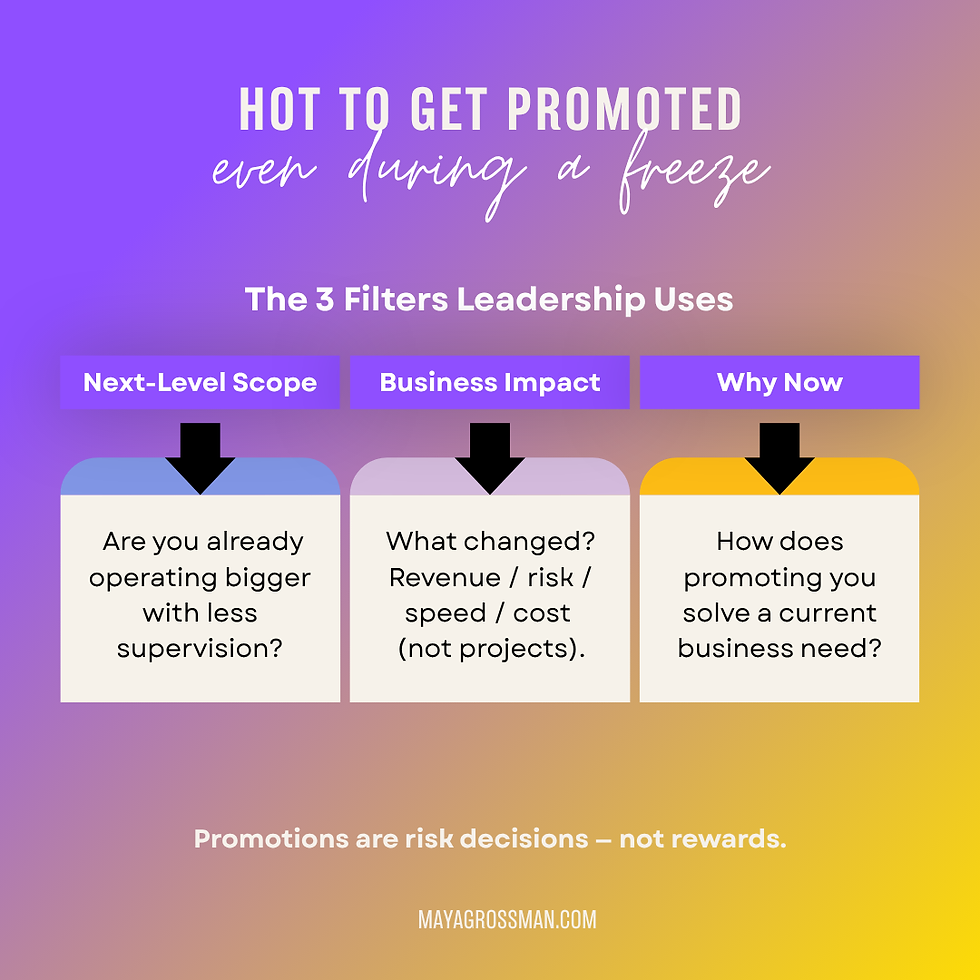
How One Director Got Promoted During a Hiring Freeze
One of my clients wanted a promotion. He was already operating at the next level, carrying broader scope, driving outcomes, leading across stakeholders, all of it.
His manager agreed. And then came the classic corporate speed bump: “Yes, I agree… but there’s a hiring freeze right now. I don’t know if we can get it approved.”
This is where most people either wait and hope, or start campaigning emotionally.
He did neither.
He built a business case using the template we teach inside Success Builders, and he socialized it. Not just with his manager, but with his skip level too.
And the result?
He got promoted that cycle, during the freeze.
These kinds of “promotion under constraint” decisions often come down to whether someone is already operating and perceived at the next level, something closely tied to the patterns discussed in Why You’re Stuck in Mid Management.
They made an exception because the case made two things undeniable:
what he had already been doing at the next level
why it would be a smart business decision to formalize it
At senior levels, the promotion goes to the person who makes the decision easy to justify.
What Executives Are Actually Asking In Promotion Conversations
Promotions at senior levels are not rewards. They’re risk decisions.
Leadership is thinking about:
Will this person create leverage at the next level, or do the same work with a shinier title?
Will they raise the ceiling for the team, or stay stuck in execution?
Will they make decisions and drive outcomes, or need constant backup?
So you’re not defending your performance.
You’re showing your readiness.
And readiness is not a vibe. It’s evidence.
And readiness is often shaped by whether anyone in leadership is actively advocating for you.
The 3 Promotion Criteria Leaders Use For VP Roles
When leaders evaluate whether to promote you, they’re usually running three filters. If your answer doesn’t address these, you’re making it harder than it needs to be.
1) Next-Level Scope
Are you already operating at the next level?
This is not “could you grow into it someday.” It’s: do you show up like it now?
Are you shaping direction or just executing someone else’s?
Are you making hard calls or outsourcing decisions upward?
Are you owning cross-functional outcomes or staying in your lane?
At senior levels, “ready” looks like increased scope with decreased supervision.
2) Business Impact Beyond Your Team
Leadership is not about measuring how much you did. They’re measuring what changed.
They want outcomes, not activity:
decisions accelerated
risk reduced
revenue protected or grown
costs lowered
teams aligned
execution improved because the strategy got clearer
If your impact is measured with a list of projects, you’ll be seen as capable.
If your impact is measured in meaningful change, you’ll be seen as promotable.
3) Why Promoting You Makes Business Sense Right Now
This is the part almost nobody answers directly.
Executive decisions are forward-looking. The question isn’t just “what have you done,” it’s “what happens next if we give you more authority?”
Promotions are easiest to justify when they solve a business need:
increased complexity
increased scale
a gap in leadership capacity
clearer accountability
faster decision-making
Why Most Promotion Answers Sound Weak To Executives
This is where smart leaders accidentally sabotage themselves. They say something that feels reasonable, but it signals the wrong thing.
One of the root causes is actually communication style.
What you say: “I’ve been working really hard.”
What leadership hears: “I don’t know how to justify this.”
What you say: “I’ve taken on more responsibility.”
What leadership hears: “Cool. More work. But is it bigger work?”
What you say: “I’ve exceeded expectations.”
What leadership hears: “That’s performance. I’m evaluating impact.”
What you say: “I’m ready for the next level.”
What leadership hears: “Based on what evidence?”
What you say: “I care deeply about the team.”
What leadership hears: “Great human. Can you drive outcomes through influence?”
None of these statements is “bad.” They’re just weak arguments for a senior promotion.
Because the decision isn’t about your effort.
It’s about whether the business should place a bigger bet on your potential.
Let me show you how to answer this question the right way.
The BET Framework For VP Promotion Conversations
Here’s the simplest way to structure your answer without rambling or listing your resume.
I call it the BET Framework, because a promotion is exactly that: a bet.
B = Business Need
What does the business need right now that your promotion helps solve?
E = Evidence
What proof shows you are already operating at that level?
T = Trajectory
What will you own next, and what will that unlock?
If you can hit those three, you’ll sound like a senior leader even if your heart is pounding.
A 60-Second Script For Promotion Conversations
Use this as a simple script for how to start the conversation:
“The business needs [business need] right now because [why it matters]. Over the last [timeframe], I’ve already been operating at that level by [evidence: scope, decisions, influence], which led to [business outcomes]. Promoting me now would formalize the scope I’m already carrying and allow me to drive [next 1 to 2 priorities] so we can achieve [future result].”
That’s the executive version of this answer. Clear, business-first, forward-looking.
How To Pressure-Test Your Promotion Case
Before you walk into the conversation, run your answer through these three filters:
If I removed the title I want, would this still sound like next-level scope?
Are my examples outcomes, or are they just tasks with nicer packaging?
Did I explain why this helps the business now, or did I just explain why I want it?
If you can answer those cleanly, you’re in a strong position.
If your role still doesn’t naturally position you for this kind of framing, it may be worth revisiting how your scope is designed, I expand on that in How to Make Your Role More Strategic
The One-Page VP Promotion Business Case Template
Here’s the part that makes this feel real.
A great BET answer is what you say out loud. The one-page business case is what makes it credible and easy for other people to repeat when you’re not in the room.
This is not a deck. It’s not a manifesto. It’s one page.
One-Page Business Case Structure
1) The ask (1 sentence)
“I’m requesting a promotion to [role] to formally align my scope to the level of responsibility I’m already carrying and to enable [business outcome].”
2) Next-level scope you already own (3 bullets)
“I currently lead [scope] across [teams/stakeholders].”
“I make decisions on [high-stakes area] with minimal oversight.”
“I represent the function by [influence/leadership behavior].”
3) Business outcomes you’ve driven (3 bullets)
“Result: [metric or outcome] through [your leadership].”
“Reduced risk / improved efficiency by [specific change].”
“Created leverage by aligning [group] around [priority].”
4) Next 90 days at the next level (2 to 3 bullets)
“In the next quarter, I will own [priority] to drive [outcome].”
“I will lead [cross-functional effort] to unlock [result].”
“I will create [system/process/decision cadence] to improve [business metric].”
This is exactly why my client got promoted during a freeze. Leadership didn’t just hear confidence. They saw a business case.
How To Start Building Your Promotion Case This Week
Start building your case for the promotion. Open a doc and write your BET answer in 10 minutes. Then write the one-page business case right under it.
If your answer sounds like a performance review, rewrite it. If you don’t have enough scope or evidence, that’s what you need to work on before the next promotion conversation.
If you are aiming for a Director or VP promotion, the goal is not to show you are busy.
It’s to make the decision easy.
I believe in you, and I’m rooting for you
Maya❤️


