How To Position Yourself For A VP Role: A 6-Step Framework

You can update your LinkedIn headline. Rewrite your resume. Choose three words you want people to associate with you: Strategic. Innovative. Transformational.
It feels like you have positioned yourself for VP.
But when promotion conversations happen, senior leaders still see you as a strong Director. You keep getting pulled into the same type of work. The opportunities coming your way look a lot like the ones you already have.
That is because positioning is not a messaging exercise. At the Director level, your reputation is often built around what you personally deliver. At the VP level, leaders need to see what you can own, influence, and make happen through an organization.
That shift is what your positioning needs to communicate.
Learning how to position yourself for a VP role isn't about creating better messaging. It's about changing the evidence and reputation that surround your name. The problems you're trusted to solve, the conversations you're invited into, and the leaders who advocate for you all shape whether you're seen as VP-ready.
Your LinkedIn profile can communicate your positioning.
It cannot create it.
Real positioning changes what people believe you are capable of. It changes the problems they trust you to solve, the conversations they include you in, and the opportunities they associate with your name.
You need that whether you are trying to get promoted inside your company or become credible for VP roles elsewhere.
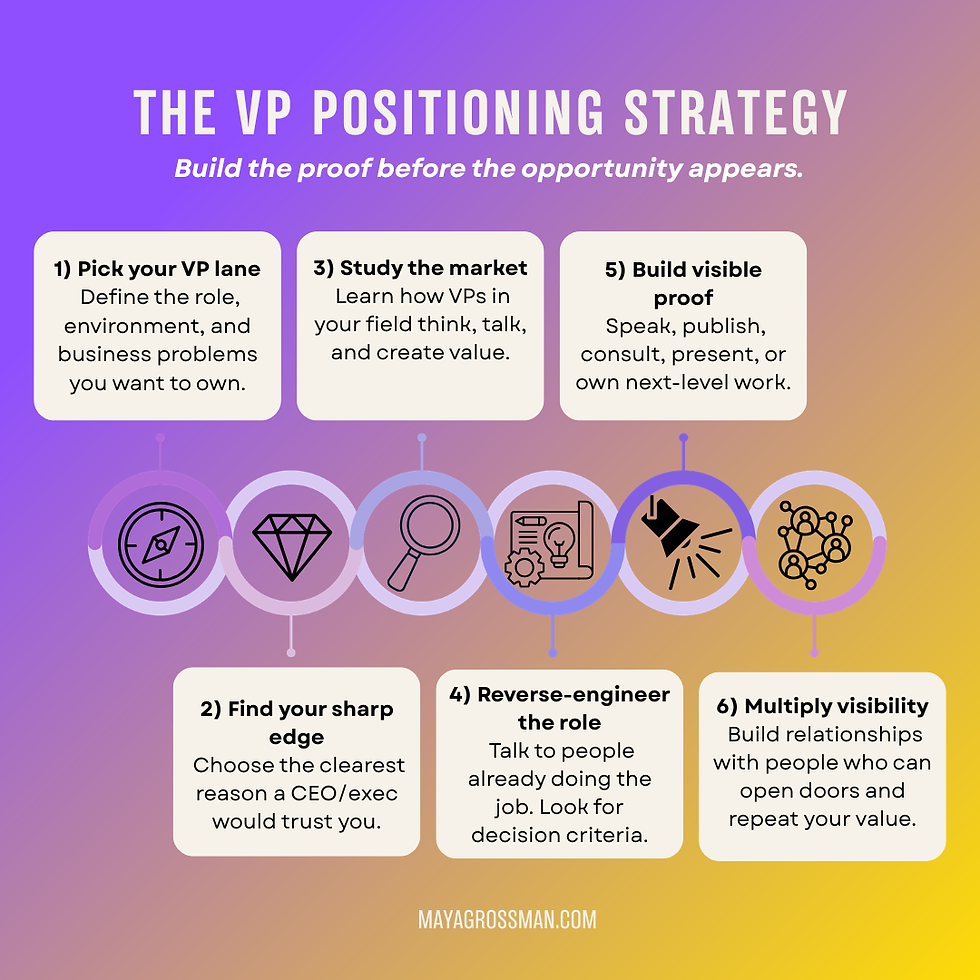
The VP Positioning Strategy That Landed Me Two Offers
Step 1: Define the VP Role You Want to Position Yourself for
I did not begin with my LinkedIn profile.
I began by defining the role.
I knew I wanted to become a VP of Marketing inside a startup. That gave me a much more useful question:
What would make a startup CEO trust me to lead their marketing organization?
Which capabilities would matter most?
What gaps would make them hesitate?
Who would need to know me before one of those roles became available?
Those answers would have been different if I wanted to lead product marketing inside a global enterprise or run a mature demand generation organization.
“I want to become a VP” is not specific enough to guide your decisions.
You need to understand the environment you want to lead in, the business problems you want to own, and the expectations senior leaders will have of someone at that level.
This is also where you start thinking beyond the function. A VP is expected to connect their function to business priorities, revenue, growth, customers, and organizational performance. So don't just ask, “What VP title do I want?” Ask, “What business problems do I want senior leaders to trust me to own?”
The clearer the destination, the easier it becomes to work backward.
And if you're trying to understand what senior leaders actually expect from someone at the next level, read more about promotion expectations here.
Step 2: Find the Sharp Edge of Your Experience
My experience was broad, but broad experience alone was not going to make my value explicit.
I decided product marketing would become the sharp edge of my positioning. It was close to revenue, and one of two main marketing disciplines that generate the most VPs.
I was not abandoning the rest of my background or pretending I had spent my entire career in one specialty. Product marketing became the part of my experience that led the story.
It gave people a clear way to understand why I was valuable.
This is where a lot of senior leaders struggle.
You have spent years developing a wide range of capabilities, so when someone asks what you bring to the table, you try to include all of them.
You describe yourself as a strategic, cross-functional leader who drives transformation, builds high-performing teams, and delivers results.
All true.
Also true of thousands of other leaders.
You do not need to erase the breadth of your experience. You need to decide which part should lead.
Your sharp edge should become the entry point to your executive story. It gives senior leaders a reason to remember you, while the rest of your experience becomes evidence of how broadly you can operate.
What is the clearest reason a senior executive would pull you into an important conversation?
Which business problem are you unusually well equipped to solve?
What part of your experience is most relevant to the VP role you want?
For me, it was competitive go-to-market motions. I knew how to find the right customers at scale. That meant that every marketing tactic that came after that was 10x more effective. And that was something CEOs wanted.
That is the sharp edge of your positioning.
It also becomes part of your executive narrative — the story that helps other people quickly understand your value, your impact, and why you belong in bigger conversations. I expand more on building an executive narrative here.
Step 3: Learn How Your Market Thinks and Talks
Once I chose product marketing, I went deep.
For almost a year, I regularly listened to six or seven podcasts focused on product marketing.
I learned who the respected experts were, which ideas were shaping the field, what companies were struggling with, and how the strongest leaders explained their impact.
I also joined the Product Marketing Alliance because I wanted to be around people who were already operating in that world.
I paid attention to the terminology they used, the problems they prioritized, and the trends executives considered valuable enough to invest in.
I was not simply learning more about product marketing.
I was studying the executive conversation and what VPs in particular were focused on.
You can have excellent experience and still struggle to position it if you do not understand how senior leaders value that experience.
Your work may be strategic, but if you describe it through tasks and deliverables, people may still see you as tactical.
Strong positioning requires you to understand what matters to the leaders making decisions:
What problems are becoming more urgent?
What results are executives accountable for?
Where is the business investing?
What separates solid functional leadership from executive-level judgment?
You're essentially learning the criteria senior leaders use to decide who gets bigger problems, broader scope, and eventually bigger titles. Once you understand those criteria, you can deliberately look for opportunities to demonstrate them in your current role.
The deeper I went, the easier it became to connect my experience to the issues senior leaders already had on their minds.
Step 4: Reverse-Engineer Leaders Already Doing the Job
At the same time, I began reaching out to senior marketing leaders on LinkedIn, especially VPs who had come from product marketing backgrounds.
I wanted to understand how they had positioned themselves.
Which experiences did they emphasize?
How did they describe their work?
What helped them move from functional leadership into an executive role?
What patterns could I see across their careers?
I documented everything I learned and gradually built a playbook for the day I became a VP.
This was networking, but it was also market research.
You can apply the same strategy to your field.
Find leaders at the VP level who have a similar background and reach out. Ask for an opportunity to learn about their journey as you are designing your next move.
Pay attention to how they communicate, which problems they own, who relies on their judgment, and what evidence made senior leaders believe they were ready.
Do not copy their career. Look for the decision criteria hiding inside it.
Start applying it in your day-to-day.
And remember, visibility is not just about being seen. It is about being seen for the right things. Read more about strategic visibility for Directors here.
Step 5: Build Proof Before You Need the VP Title
Joining the Product Marketing Alliance eventually created an opportunity I could not have planned.
A few weeks before one of their events, they reached out and asked whether I could deliver a keynote. Someone may have canceled. I did not have a ready-made presentation, and I was scared shitless.
I said yes.
I knew the opportunity could help establish credibility in the exact space I wanted to own.
(Side note: you don’t have to wait to get invited. You can reach out and pitch yourself)
The keynote was recorded, and I shared the video on LinkedIn. That one piece of visible proof started creating opportunities. CEOs and senior executives reached out to ask whether I offered consulting.
As I did more product marketing work as a consultant, my positioning became more credible.
At the time, I was already working on a project with Google, but it wasn’t giving me enough of the go-to-market exposure I needed. So I put together a plan to expand my scope and pitched it. They said yes, and I strengthened the exact reputation I was building while doing meaningful work.
The keynote created public proof.
The consulting work created operating proof.
Together, they changed the story I could tell, and that changed how people saw me.
This is the part you cannot solve with a better LinkedIn headline.
You need evidence.
Inside your company, that might mean taking ownership of a strategic initiative, expanding the scope of a project, advising another function, presenting to senior leaders, or solving a problem that normally sits one level above you.
The goal isn't to collect impressive projects for your resume. It's to create evidence that answers the questions executives are already asking about VP candidates: Can this person think beyond their function? Can they influence without authority? Can they lead through ambiguity? Can they make decisions that move the business forward?
Those are the kinds of proof points that make your positioning believable. Here’s how I think about building promotion proof points.
Externally, it could mean speaking, publishing, consulting, advising, or contributing to an industry community.
Your positioning becomes believable when people can see you doing the work, not just talking about it.
And no, this isn’t a quick fix. It’s a process that builds reputation, but when it finally falls into place, you get to reap the rewards for the rest of your career.
Step 6: Build Relationships that Multiply Your Visibility
By the time I was ready to pursue a VP title, my positioning was already working.
My network had seen my expertise develop. I had speaking experience, consulting projects, and stronger examples that supported the story I wanted senior leaders to believe.
Then I became more deliberate about who needed to know me.
It’s easy to think that if you just update your LinkedIn, opportunities will magically come, but we’re not here to play the ego game. Waiting is not a strategy.
If you want visibility, you need to create it.
Because I wanted to lead marketing inside a startup, I reached out to partners in venture capital firms.
One VC relationship could potentially open doors to multiple companies. An investor recommendation would also carry more weight with a startup CEO than a cold application.
By that point, I was not asking anyone to imagine whether I could operate at the VP level.
I had evidence that I already was. And (and this is an important one) after dozens of networking conversations with senior leaders, I also had the confidence to tell my story.
That made it easier for senior leaders to recommend me, and those conversations eventually led to two VP offers.
The same principle applies internally.
You need relationships with people who influence opportunities. That might be your skip-level leader, a respected cross-functional executive, a business-unit leader, or someone who regularly participates in talent conversations.
Positioning becomes much more powerful when the right people can see it and repeat it when you are not in the room.
Your job is to make it easier for them to see and advocate for you.
That is also why learning how to communicate like an executive matters. Your positioning has to show up not only in your profile, but in the way you speak, make decisions, and communicate with senior leaders.
VP Positioning Starts Before the Opportunity Appears
The process of positioning myself for those two VP offers I landed? It took about a year because I started from zero right after moving to a new city and with no network to support me.
You might need 90 days if you have a good baseline, but the bottom line is that it’s not something you do over a weekend.
You do not build VP positioning during the final weeks before a promotion decision.
You build it through the strategy you follow and the choices you make long before that conversation happens.
Your resume and LinkedIn profile should reflect that strategy. But they are not the strategy. The strategy is deciding what you want to be known for, building evidence that supports it, and making sure the right leaders see that evidence before a VP opportunity opens.
I’m sorry I can’t give you a quick fix, but what I can offer is this: your brand and your positioning are one of the things no one can take away from you. Once you build them, they will continue to serve you and future-proof your career.
Your Next Steps: The 6-Step VP Positioning Playbook
If you want to get started, follow these six moves to build your plan:
Target: Define the VP role and business environment you want.
Sharpen: Choose the part of your experience that should lead your story.
Immerse: Learn the priorities, language, and trends shaping that space.
Study: Reverse-engineer the leaders already trusted at that level.
Prove: Create visible evidence that you can solve VP-level problems.
Multiply: Build relationships with leaders who can help your reputation travel.
Your goal is not to tell people you are ready for VP. It is to make the evidence strong enough that they reach that conclusion themselves.
Positioning is only one part of getting promoted to VP. You also need to know what senior leaders are looking for, how to demonstrate executive-level impact, and how to make your readiness visible.
In this free training, you'll learn how Directors in tech can position themselves to become the obvious choice for VP, and what to focus on before the next promotion conversation happens.
I believe in you, and I’m rooting for you
Maya❤️


