Managing Up As A Director When Your Manager Is Absent Or Chaotic

Have you ever felt like no matter how hard you try, you’re just treading water?
If you’re a Director trying to grow into a VP role, managing up becomes critical, especially when your manager is absent, unclear, or constantly shifting direction.
You’re trying your hardest and yet…
Your VP is:
Always in firefighting mode
Avoiding hard decisions
Giving vague feedback like “keep doing what you’re doing”
Changing priorities every two weeks
Or worse… politically fragile and protecting themselves
And now you’re stuck.
No clear KPIs. No aligned expectations. No real feedback. No advocacy.
Just ambiguity and hope.
Instead of clarity, you get vague feedback. Instead of alignment, you get changing priorities. And over time, that doesn’t just slow you down, it puts your promotion path at risk.
If you’re ambitious, this is not just frustrating.
It’s dangerous.
Because the longer you operate without clarity, the more you start managing for survival instead of for promotion.
Because at this level, waiting for direction is no longer neutral. It’s a liability.
The leaders who get promoted aren’t the ones with perfect managers.
They’re the ones who know how to create clarity anyway.
And here’s the uncomfortable truth:
At the Director and Sr. Director level, you no longer get to wait for clarity.
You have to manufacture it.
This is what managing up as a Director actually looks like in practice.
Let me show you how.
Why Managing Up Is A Requirement At Director Level
When leadership above you is messy, three things quietly happen:
1. Your Goals Become Guesswork
Without clearly defined KPIs or agreed-upon outcomes, you start optimizing for activity instead of impact.
You overwork.
You over-deliver.
You try to cover every angle.
But when review season comes, you struggle to articulate what “winning” actually meant.
And if success was never clearly defined, it’s very hard to prove you achieved it.
2. Your Feedback Loop Breaks
If your manager avoids conflict or doesn’t give constructive input, you lose calibration.
You don’t know:
Where you’re strong.
Where you’re misaligned.
Whether you’re operating at executive altitude.
Over time, this creates self-doubt or false confidence. Neither is helpful.
3. Your Promotion Path Becomes Fragile
If one unstable leader controls your narrative upward, your career becomes dependent on their competence and political strength.
That’s not strategic. That’s risky.
And the longer you tolerate it, the more it looks like you need it.
How To Manage Up When Your Manager Is Absent Or Chaotic
When your manager is absent or chaotic, your job changes.
Not officially.
But in reality.
You stop being someone who waits for direction. You become someone who creates operating stability.
Here’s what that actually looks like.
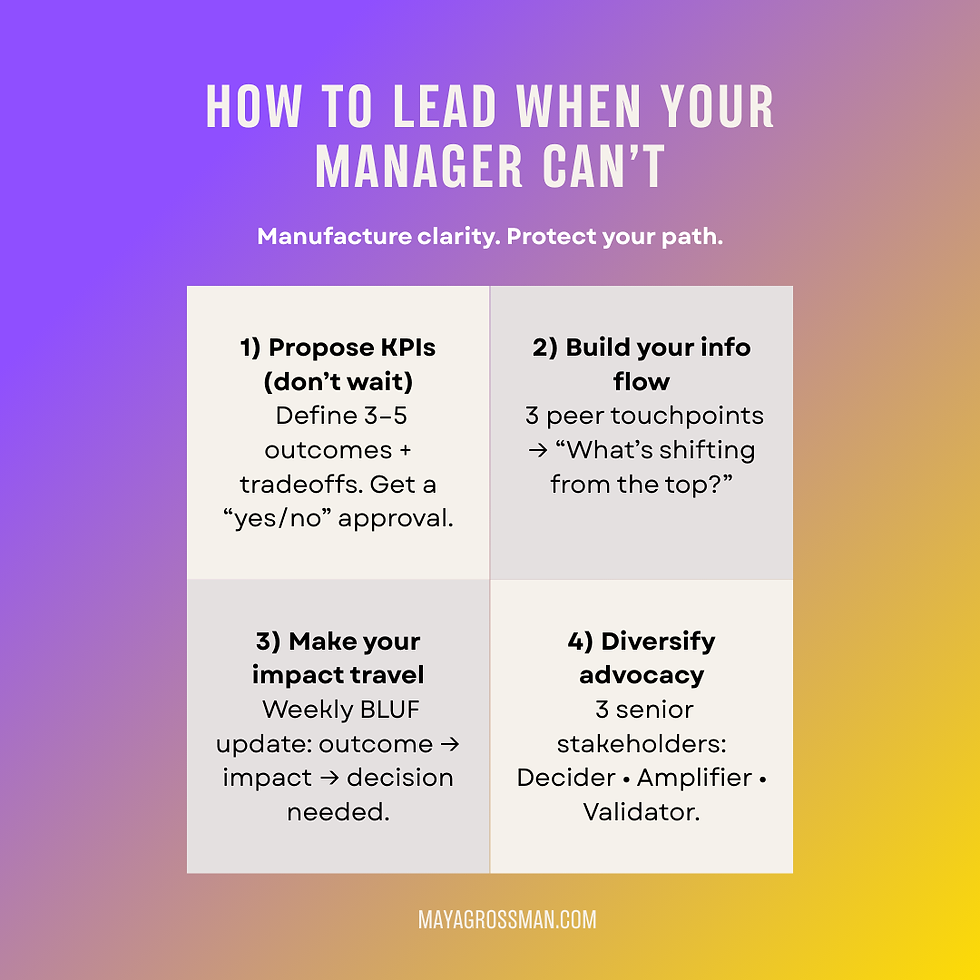
1. Create Clear KPIs Instead Of Waiting For Them
The cost of waiting:
You drift. You stay busy. You ship things.
You’re moving a million individual parts, but not the ship.
That means you don’t have leverage. And when promotion conversations happen, you can’t clearly point to what you were actually hired to win, even though your calendar is exploding.
If success is vague, your impact will be too, and that makes it almost impossible to position yourself for a VP promotion. I explained this further in my guide.
Instead of asking: “What are my goals?”
Propose them.
For example:
“Based on where the company is headed and what our function actually controls, here are the four outcomes I believe we should own over the next two quarters. If we hit these, we move revenue, cost, or risk in a real way. Does this align?”
Notice the shift.
You’re not asking for direction.
You’re offering a clear path and just asking for confirmation. It works because it takes off some of the pressure. Your manager doesn’t need to come up with the answers, just approve your direction.
But, how do you come up with a plan when there’s ambiguity and little direction?
Tie your KPIs to business outcomes, not activity.
Pick 3–5 real results, not a laundry list of tasks.
Be explicit about trade-offs so it’s clear what won’t get done.
Follow up in writing so expectations are documented.
This isn’t overstepping. It’s removing guesswork.
And executives trust people who remove guesswork.
This is the shift from executing work to defining what success looks like, which is exactly how VPs operate. This is also one of the clearest signs of an executive readiness for Directors, the ability to create clarity and direction even when the environment around you lacks it.
2. Build Your Own Information Flow to Reduce Political Blind Spots
The cost of waiting for information to trickle down:
If information from the top is inconsistent, you operate with half the story.
Then you get surprised.
Then you look reactive.
When your manager is chaotic or doesn’t share information, you have to find other ways to get informed. That means building lateral intelligence.
Strong relationships with peer Directors.
Regular alignment conversations that aren’t just status updates.
Smart, neutral questions like:
“What themes are you hearing from the top right now?”
“Anything shifting that could affect our roadmap?”
At senior levels, context is everything. The people with context make better decisions. The people without it look like they lack judgment. Don’t be the second one.
I break this down further here.
At VP level, decisions are judged by context, not effort. Managing up means making sure you have the context others don’t.
3. Design a Visibility Strategy That Doesn’t Depend on One Person
The cost of relying only on your manager to advocate for you:
If they don’t talk about you, you don’t exist.
And if they’re politically cautious, insecure, or just overwhelmed, you become invisible by default.
That’s too risky.
You need a visibility plan that goes beyond your manager.
Here are a few things you can do:
Send structured updates that tie your work to business outcomes
Share progress in exec-facing forums when appropriate
Document impact in writing (use before and after to show impact)
Instead of: “We completed the migration.”
Say: “This initiative reduced operational risk by X%, improved time-to-market by Y%, and sets us up to support next year’s growth.”
Same work. Different altitude.
Visibility at this level isn’t about being loud. It’s about making your impact easy for senior leaders to understand, repeat, and advocate for. This is also why learning the art of self-promotion matters so much at senior levels.
4. Protect Your Promotion Path (Reduce Single Point Of Failure)
This is the uncomfortable one.
If your entire promotion path depends on one VP’s advocacy, you are exposed.
That’s a single point of failure.
And when leadership is unstable, that risk goes up.
So you diversify credibility.
Build real trust with multiple senior stakeholders.
Own cross-functional work that puts you in higher-level conversations.
Make sure your skip-level knows you for judgment and outcomes, not drama.
You are not bypassing your manager. You are protecting your future.
There’s a difference.
Directors who rely on a single VP for advocacy often stall. Directors who build broader credibility get pulled into bigger opportunities.
The Emotional Trap That Keeps You Stuck In Reactive Mode
When your manager is absent or chaotic, resentment builds fast.
You think:
“I shouldn’t have to do this.”
“This is literally their job."
“This isn’t fair.”
All true, but irrelevant.
Staying in that mindset keeps you reactive.
And reactive leaders rarely get promoted.
The people who rise in messy environments aren’t the ones who complain the most.
They’re the ones who quietly create order.
Ironically, many of the behaviors that accelerate promotions are not flashy at all. They’re often the consistent, strategic habits I talked about here.
They clarify. They connect dots.
They bring structure where there isn’t any.
And over time, everyone starts to feel the difference.
That is what managing up well really means.
Managing up is not about fixing your manager. It’s about demonstrating that you can operate at the next level, regardless of the environment.
A Simple Way To Start Managing Up This Week
This week, pick the area where ambiguity is costing you the most:
Unclear KPIs
No real feedback
Political blind spots
Weak visibility
This week, define one area where expectations feel vague and draft the version you would operate under if you were already the VP.
Send it for alignment.
That’s how you stop being managed and start being seen as executive material. If you’re constantly compensating for unclear leadership, it’s easy to feel like you’re working harder but getting less recognition.
The reality is, promotion at this level isn’t about doing more. It’s about being seen as someone who can operate at VP level, even in imperfect environments.
In my free training, I break down exactly how Directors in tech become the obvious choice for VP, without waiting for perfect conditions.
I believe in you, and I’m rooting for you ❤️
P.S.
Managing up is a skill. It doesn’t mean you have to tolerate chronic dysfunction.
If most of your energy is spent compensating for your VP instead of building your own executive muscle, this environment will limit your growth.


