Executive Presence In Meetings: Why Smart Leaders Still Shrink In Senior Rooms

You can be brilliant in your domain… and still shrink the moment you enter a senior room.
You can be exceptional at your job and still lose executive presence the moment you walk into a senior room.
Many Directors in tech know their numbers, strategy, and operations deeply, but when they enter meetings with the SLT, board, or CEO, something shifts. Their voice softens. They hedge. They wait to be invited into the conversation.
Not because you’re not capable. Because the room feels bigger than you.
The problem is, executive presence in meetings is not just about confidence. It’s about perceived leadership readiness.
Silence at this level signals uncertainty.
At senior levels, communication is interpreted symbolically. People are constantly evaluating confidence, judgment, and leadership readiness through behavior, not just ideas.
And when you consistently shrink in high-stakes rooms, senior leaders don’t interpret that as humility. They interpret it as uncertainty.
When you shrink in senior rooms, people don’t think you’re humble.
They wonder if you believe in your own strategy.
And that kills your presence (and your promotion).
Executive presence is not about dominance. It’s about helping the room trust your thinking under pressure. This is also why developing magnetic executive presence has less to do with charisma and more to do with how consistently people trust your judgment in high-stakes situations.
The First Time I Shrunk in a Board Meeting
The first time I joined a board meeting, I was intimidated.
I barely spoke. I didn’t ask questions. I didn’t push back.
I was a very quiet mouse.
I knew I didn’t make the best impression, but I didn’t realize the impact until later.
My CEO had to circle back with the board to answer follow-up questions about our marketing strategy. They weren’t fully convinced.
And I believe now it wasn’t because the strategy was weak.
It was because I kept myself small in that room.
My silence was interpreted as a lack of confidence in the plan.
And if the person closest to execution doesn’t sound convinced… why should the board be?
That’s when I learned something critical: Shrinking in senior rooms doesn’t protect you.
It undermines your presence and your power.
I knew I had to change that, so I worked with a coach.
Not on my slides. Not just my talking points.
In my belief.
Specifically: that my voice mattered in that room.
At the next board meeting, I showed up differently.
I volunteered to speak. I anticipated objections and addressed them before questions were asked.
I prepared deeply, not just on content but on positioning.
And I spoke with conviction.
This time, there were no pushbacks. No insecurity about the direction.
In fact, one of the board members circled back afterward and offered to get on a call to get better acquainted.
That’s the difference between shrinking and holding your ground with executives.
And you can do it too.
I realized later that the board wasn’t only evaluating the strategy. They were evaluating whether I could confidently lead it.
Why Shrinking In Executive Meetings Hurts Your Promotion Path
I’ve coached enough executives to know shrinking is a common reaction. But I want you to see the real cost isn’t just visibility. When you shrink in senior rooms:
You get labeled “strong operator” instead of “strategic leader.”
You weaken sponsorship because no one bets on uncertainty. This is one of the reasons I emphasize visibility and executive communication so heavily here.
You slow your path to VP without realizing it.
Executives are not just evaluating your ideas.
They are evaluating your behavior under pressure.
If you keep shrinking in high-stakes rooms, you will not be trusted with higher stakes.
Here’s what you can do to overcome this instinct and stop shrinking yourself:
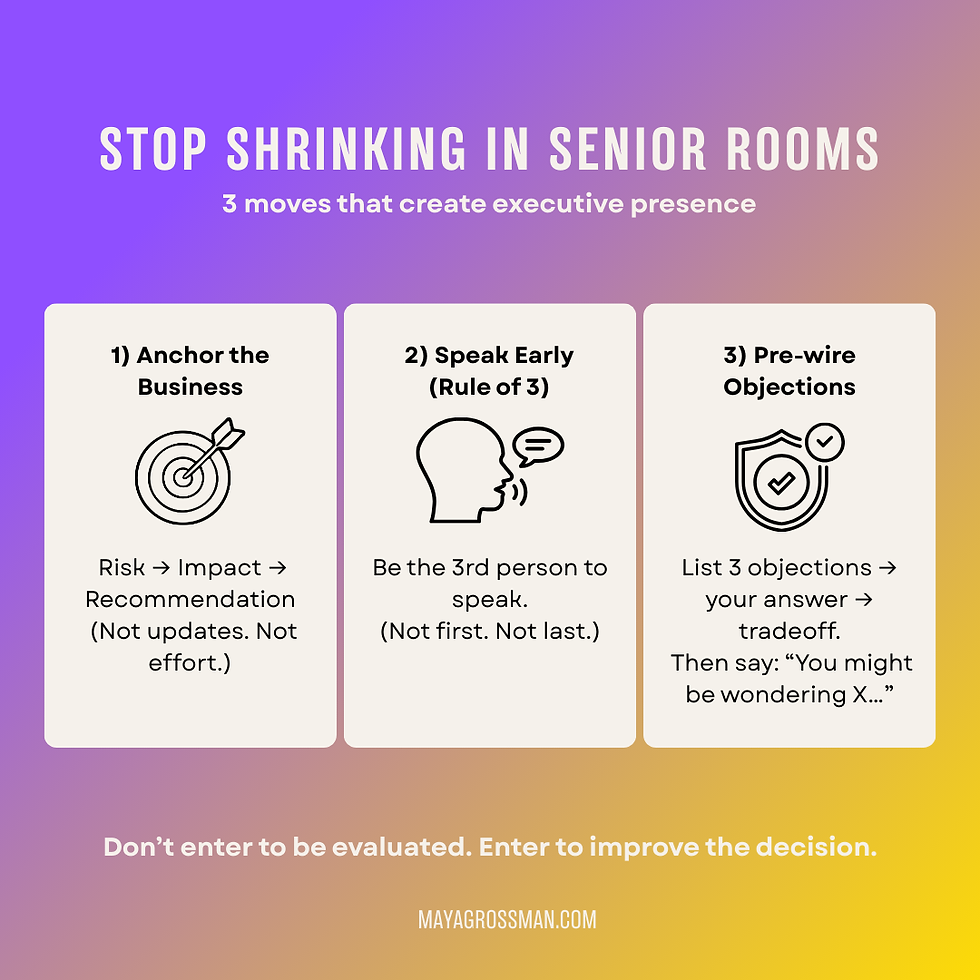
1. Anchor the Business, Not Your Nerves
Most high performers walk into senior meetings thinking:
“Do I belong here?”
Executives anchor themselves in outcomes, tradeoffs, and decisions, not in whether they personally sound smart.
The moment you focus on yourself, you contract.
The moment you focus on the decision, you expand.
Not to mention, if you are in the room, you don’t need to earn the right to be there, you need to justify your choice. They already believe you belong, prove them right.
The Business Anchor Method
Before any senior meeting, run your input through this filter:
Risk → Business Impact → Recommendation
Not updates. Not activity. Not effort.
Instead of:
“We’re making progress, but there are a few challenges.”
Try:
“If we don’t address X, we risk delaying revenue by a quarter. My recommendation is we reallocate resources now to protect the launch.”
This is what I did differently in the second board meeting.
I didn’t wait to defend the strategy. I pressure-tested it out loud before anyone else could.
That’s ownership.
2. Don’t Wait To Speak — Take Space Early
In senior rooms, silence is rarely neutral.
It is interpreted as agreement, or lack of perspective.
None of those help you. Especially if you have something to say.
But I know it’s scary to speak. You’re thinking: what if I say something stupid? What if they don’t agree?
Those are possible scenarios, but that’s part of being an executive. Driving a meaningful discussion.
To roughly quote Leila Hormozi: the best executives are those who question your thinking. They shift your perspective or belief and make you reevaluate. It’s not those who agree with you all the time.
The First 3 Rule
If you are too worried about being the first to speak, but you want to avoid missing your chances, follow the rule of 3. Be the third person to speak.
It takes of the pressure of being first, you can see where the discussion is going and tailor your pitch. But it’s not too late that the room is convinced and there’s nothing to add.
Being specific about your place in line also forces you to speak early instead of waiting for an opening.
In my second board meeting, I didn’t wait to be asked. I volunteered to speak.
That one decision changed the entire energy.a
One of the fastest ways to build executive presence is to contribute before the room fully settles around a direction.
3. Anticipate Objections Before They Surface
One of the biggest differences between shrinking and holding your ground?
Preparation.
Shrinking can be a byproduct of uncertainty. When we don’t know how people will react, whether we’ll get support or push back we choose to avoid the conflict altogether.
The result? Shrinking.
That’s what I did in the first board meeting. I stayed quiet hoping they won’t ask me tough questions.
The second time, I expected them. And answered them before they were asked. I explained this preparation process further in my guide.
Instead of hiding I chose to prepare and confront.
That’s what executives do.
Strong executives don’t avoid tension. They demonstrate they can navigate it calmly.
Practical Shift: Pre-Wire the Tension
Before a high-stakes meeting, write down:
The three toughest objections you might face.
The data or logic that addresses each one.
The tradeoffs you’re willing to acknowledge.
Then speak to those proactively.
“Some of you may be wondering about X. Here’s how we’re thinking about it.”
When you surface tension calmly, you signal control.
That’s executive presence in action.
The Identity Shift Behind Executive Presence In Meetings
Here’s what changed for me more than anything:
I stopped entering rooms to be evaluated.
I started entering rooms to elevate the quality of the decision.
That shift is part of thinking like an executive, moving from self-protection toward ownership of business outcomes and decision quality.
Managers often protect themselves. Executives protect the business outcome, even when conversations become uncomfortable. Part of leadership maturity is also learning how to set boundaries like an executive.
If you are still shrinking in senior rooms, it’s not because you’re incapable.
It’s because part of you is still trying to survive the room instead of lead it.
And that’s an identity decision, not a skill gap.
Choose to make it.
Your Next Steps
Pick one of these for your next senior meeting:
Use the Business Anchor Method.
Apply the First 3 Rule.
Pre-Wire the Tension For Your Next Presentation
You don’t have to try all three at once. Choose one and take action this week.
I still feel like shrinking sometimes before a big meeting.
The difference is, I don’t let it lead me.
If you know you’re capable of operating at a higher level but still find yourself shrinking in executive conversations, you’re not alone.
Most Directors were taught how to execute, not how to project confidence, influence decisions, and build executive presence under pressure.
In my free training, I break down how Directors in tech become the obvious choice for VP by strengthening executive presence, strategic visibility, and leadership positioning.
Will you?
I believe in you, and I’m rooting for you,
Maya❤️


